
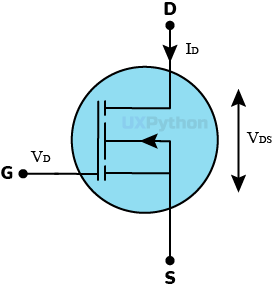
The 16N50 is a N-Channel metal-oxide semiconductor field-effect transistor (MOSFET) is the most common type of field-effect transistor (FET). This transistor has a three-terminal device with Gate (G), Drain (D) and Source (S) terminals.
Circuit diagram symbol of the 16N50 transistor as follows.
| Transistor Code | 16N50 | |
|---|---|---|
| Transistor Type | MOSFET | |
| Control Channel Type | N-Channel | |
| Package | TO-220F2_TO-220F1 | |
| Drain-Source Voltage (Maximum) | VDS | 500V |
| Gate-Source Voltage (Maximum) | VGS | 30V |
| Drain Current (Maximum) | ID | 16A |
| Drain-Source On-State Resistance (Maximum) | RDS(on) | 0.31Ohm |
| Power Dissipation (Maximum) | PD | 62W |
| Drain-Source Capacitance | 235pF | |
| Operating Junction Temperature (Maximum) | 150°C | |
| Rise Time | 150nS | |
The 16N50 is a transistor, a MOSFET, used for on and off switching in electrical gadgets and power control applications. It is a N-Channel MOSFET, which means it conducts when a positive voltage is applied to the gate with respect to the source.
This device comes in a TO-220F2_TO-220F1 package, making it suitable for projects that require moderate power handling and reliable switching performance.
Followings are the key electrical characteristics of the 16N50 MOSFET transistor
The maximum drain-source voltage that can safely block between drain and source in 16N50 MOSFET transistor is 500V.
This is the highest voltage the MOSFET transistor can safely block between the drain and source without damadging to the transistor.
The maximum safe voltage that can be used between the gate and source of the 16N50 MOSFET transistor is 30V without any harm. This limit should not be exceeded to prevent damage from the gate voltage.
The maximum continuous current flowing between the drain and source of the 16N50 MOSFET transistor is 16A. This is the highest current that can safely flow between drain and source without damaging the MOSFET transistor.
The internal resistance between the drain and source of 16N50 MOSFET transistor when the transistor is fully turned on is 0.31 Ohm that defines the amount of lost power that is wasted as heat when the transistor is operating.
The maximum power that the 16N50 MOSFET transistor can comfortably transfer into heat without breaking is 62W. This indicates the amount of power that can safely be dissipated to the device as heat.
The capacitance between drain and source of the 16N50 MOSFET transistor is 235pF. This value influences to the switching speed of the 16N50 MOSFET transistor and the high-frequency performance.
This is the ability to hold a small electric charge between the drain and source of a MOSFET transistor, like a tiny built-in capacitor.
The time that the drain current or output voltage increases between low to high when the 16N50 MOSFET transistor is switched on is 150nS. This is the rate at which 16N50 MOSFET transistor switches on.
This shows how fast the MOSFET transistor switched on.
The maximum internal temperature of the semiconductor junction of 16N50 MOSFET transistor can be safely operated at the 150°C without damaging the transistor.
UXPython is not the creator or an official representative of the 16N50 MOSFET transistor. You can download the official 16N50 MOSFET transistor datasheet to get more infromation about this transistor.
Note : Copyrighted materials belong to their creator or official representative.


Copyright © UXPython inc. All rights reserved.
Devoloped by UXPython.